Loading...
Turn client visions into personalized retirement income strategies
Designing retirement income plans around client goals
Key insights from my white paper "Navigating critical decisions in developing a retirement income plan"
Steve Vernon, FSA®, President, Rest-of-Life Communications

Key takeaways
- Asking open-ended questions early helps ensure that the income plan is built around what truly matters to them
- Talking to both partners individually can help uncover differing priorities, giving you clearer insights into designing a plan that works for all
- Matching stable income sources such as Social Security, annuities or in-plan lifetime income options to core living costs can give clients more confidence to use other assets for the things they enjoy most
By the time most clients sit down to talk about retirement income, they’ve already put in decades of hard work, saved consistently and made smart financial choices. But as a financial professional, you know that the numbers are just one piece of the story. Helping clients create a sustainable, personalized income plan starts with asking the right questions about what they want retirement to look like.
What does retirement really mean to them?
Every client has their own unique vision of their retirement, and that unique vision will probably have a direct impact on their income needs. That’s why it’s important to ask clients — including both members of a couple — thoughtful, open-ended questions early in the planning process. Here are some examples.
| Topics |
Questions to ask |
Implications for the plan |
| Where they'll live |
- If you plan to move when you retire, will it result in a higher or lower housing cost?
- Are you hoping to age in place at this property, or do you expect another move down the road?
- Will your existing home equity fully cover the cost of the new property?
|
- What tax impacts might come from the move (e.g., capital gains taxes or new property tax rates)?
- If relocating out of state, how will out-of-pocket health care costs change?
|
| Daily life |
- How do you plan to spend your days when you retire?
- Do you expect your day-to-day spending to go up or down?
|
- Can their savings support their lifestyle goals?
- If they plan to work, think about how wage income in retirement will affect Social Security taxation, Medicare IRMAA surcharges or income-related tax benefits
|
| Nonstandard expenses |
What are some large expenses that could pop up during retirement (e.g., epic trips, replacing a roof, buying a new vehicle)? |
Consider how a tax-efficient retirement income strategy and sequencing withdrawals from a mix of tax-deferred, taxable and tax-free income sources can help prolong retirement savings. |
| Health and wellness |
- Do you have an idea of what your out-of-pocket health care costs might be in retirement?
- Are there any health issues that could result in higher costs?
|
|
Matching income to core retirement expenses
Once you understand a client’s retirement goals and priorities, you can start building an income plan designed to support them. One helpful framework is to think in terms of asset/liability matching. This means identifying the client’s essential expenses — such as housing, food, basic living and health care costs — and then aligning those expenses with stable income sources that can help cover them.
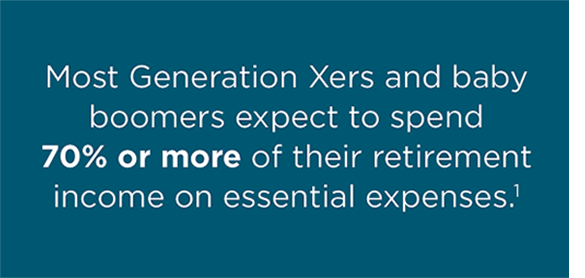
According to a recent survey by the Nationwide Retirement Institute®,
1 most Generation Xers and baby boomers expect to spend 70% or more of their income on essential expenses. Protected lifetime income sources such as Social Security, pensions, annuities or in-plan lifetime income options can play a critical role here. When these are used to help cover essential expenses, clients may feel more
confident about spending from their portfolio to fund discretionary goals, such as travel, hobbies or helping the next generation.
Offer a more personal approach to income planning
Ultimately, retirement income planning is about building a plan that fits the life that clients want to live. By asking the right questions and matching income sources to specific priorities, financial professionals can help clients feel more prepared, more secure and more excited about what’s ahead.
[1] "The Nationwide Retirement Institute® 2024 Social Security Survey," conducted by The Harris Poll on behalf of the Nationwide Retirement Institute. This online survey was conducted April 19 through May 10, 2024, among 1,831 U.S. adults age 18 or older.