Get a quote for your business or Get a quote for your employer client
Stop loss insurance, in combination with a self-funded plan, is a type of coverage that protects companies from catastrophic or unexpected medical claims.
Get a quote for your business or Get a quote for your employer client

By choosing a self-funded plan with stop loss coverage, employers limit their risk, protect themselves against high claims and have the potential for great savings. In some instances, they may even receive a refund in years when claims are lower than anticipated.1
A specific deductible is the total amount of medical claims accrued by each individual under a health plan that the employer is responsible for before stop loss coverage kicks in and pays for the rest.
An aggregate deductible is the maximum amount the employer will pay for covered charges, regardless of whether any specific deductibles are met. Once the plan hits the aggregate deductible, stop loss coverage takes care of charges under the plan for the remainder of the year.
These two deductible structures work in tandem with one another on a self-funded plan, meaning a policy will have both a specific and/or an aggregate deductible to meet.
Sometimes members won’t each hit their specific deductibles; however, they can collectively meet the business’s selected aggregate deductible for the entire group. Groups with 51 or more employees have additional options for stop loss. Learn about them below.
Example A: Plan member-specific deductibles
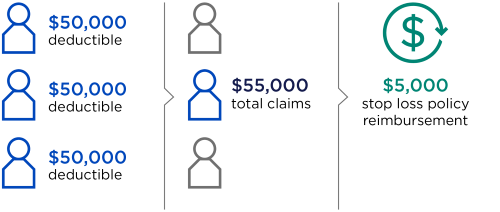
If an employer chooses a $50,000 specific deductible per plan member for that policy year and a member exceeds that liability with total claims of $55,000, for example, the stop loss coverage will reimburse the employer for the excess $5,000.
Example B: Aggregate deductible
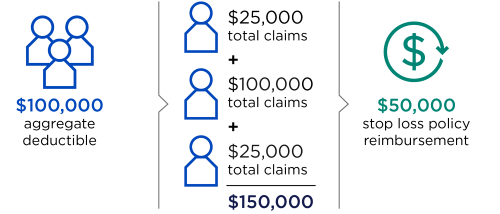
If an employer’s aggregate deductible is $100,000 for that policy year, and the group exceeds that liability and the total claims are $150,000, the stop loss coverage will reimburse them for the excess amount of $50,000.
When a business has more employees, they may need more options to customize their plan. Middle market groups, 51 to 500, have additional stop loss options to choose from.
Aggregate only stop loss is coverage with a single stop loss deductible to meet for the entire group.2
The aggregate deductibles for aggregate only stop loss coverage are based on a percentage of the total expected claims, calculated based on the census of the group and other factors. Once the health plan hits the aggregate deductible, the stop loss coverage kicks in for covered charges incurred for the rest of the plan year.
Aggregate only stop loss does not protect against an individual’s claims on the plan and instead protects only against higher-than-expected total claims. This allows the employer to take on a little extra risk and increase potential savings. Specific only stop loss is also available for traditional funded groups and provides protection solely against an individual’s claims on the plan.
[1] In years when claims are lower than expected, a portion (or all, depending on the plan selection) of the difference between the group's anticipated and actual claims is credited back to the employer. The refund is subject to any Terminal Liability Coverage fee.
[2] Aggregate only stop loss is also available for groups with 50 and under employees in the following states: MD, NJ and WV. Available in ME for groups of 11 or more employees.
The Self-Funded Program through Nationwide provides tools for employers owning small to midsize businesses to establish a self-funded health benefit plan for their employees. The benefit plan is established by the employer and is not an insurance product. Stop loss insurance policies are underwritten or reinsured by Nationwide Life and Benefits Insurance Company; refer to nationwide.com/stoplossdisclaimer for details. Product availability and specific provisions may vary by state.