Toolbox talk | Worker safety
Worker Safety: Footwear
Simplifying your toolbox talks
What you need to know about footwear
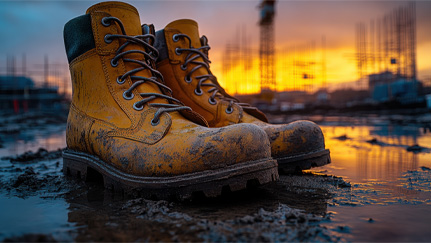
Footwear is a critical component of personal protective equipment in construction. Construction workers face higher risk of foot injury due to widespread puncture, impact, slip/trip, laceration, electrical or burn hazards on a jobsite.1 In this talk, we’ll discuss the importance of selecting and wearing appropriate footwear on the jobsite.
What You Can Do:
- Select appropriate footwear: Choose footwear suitable for your specific hazards (Impact, chemical, electric shock, waterproof, etc.). Ensure footwear meets recognized safety standards. If you don’t know, request a hazard assessment or consult with your Supervisor or Safety Manager.
- Ensure proper fit/comfort: It is important to get fitted, try footwear on and test out. Do not overlook comfort, as it is an important factor in prolonged use.
- Consistently wear: Always wear safety footwear on the jobsite, even for short tasks.
- Inspect regularly: Inspect your footwear regularly for wear issues, defects or other hazards. This is especially important for electrical hazard boots.
- Maintain: Keep your footwear clean and maintained. Rinse and clean as needed. Apply top dressings as directed by the manufacturer to extend life of footwear.
- Replace: Replace safety footwear when soles are worn out or you identify cracks, holes, tears or safety toe cap has been compromised or is damaged.
What Are the Hazards?
- Impact Hazards – Construction tools, machinery and materials
- Cut/Laceration – Cutting equipment, sharp objects on the jobsite, etc.
- Puncture/Penetration – Sharp objects like nails, glass, metal fragments, etc.
- Slip/Trip – Uneven ground, we/oily conditions, poor housekeeping, etc.
- Thermal/Chemical Burns – Heat sources like asphalt, chemical burns or caustic burns from concrete.
- Electrical Shocks – Contact with live wires, or electrical sources
- Musculoskeletal Strains – Prolonged standing can cause strains in feet and ankles
- Frostbite – Exposure to cold temps and poor footwear insulation that causes freezing of the skin and underlying tissue.
Types of Footwear Available
Footwear in construction can be either boots or shoes and may include one or more of the following features. Choose footwear that meets recognized standards like ASTM 2412 & 2143 – Standard Specification for Performance Requirements for Protective (safety) Toe Cap Footwear.
- Steel-toed boots: Reinforced steel or alloy toe cap footwear provides impact protection from heavy falling objects.
- Composite-toed boots: Non-metallic materials like Kevlar, plastic, or carbon fiber, offer impact protection and electrical hazard resistance for the toe box.
- Metatarsal boots: Extends beyond traditional toe box to protect the upper foot and metatarsal bones from heavy impacts and is often combined with steel or composite toes
- Electrical hazard (EH) boots: Insulating properties of this footwear reduces the risk of electrical shocks. EH-rated safety shoes and boots are designed to protect wearers from up to 600 volts in a dry setting
- Dielectric boots: Dielectric boots or overshoes are tested to higher voltages and capable of being used in wet conditions
- Puncture-resistant boots: Puncture-resistant midsoles are often made from Kevlar fibers/materials or steel shank that are embedded within the sole.
- Slip/skid-resistant boots: Slip-resistant soles with specialized tread patterns to prevent slip and falls on wet surfaces
- Chemical resistant boots: Are made with materials that can withstand exposure to various chemicals
- Waterproof boots: Waterproof materials and sealed seams keeps feed dry in wet conditions
- Insulated boots: Insulation materials like Thinsulate or wool keep feet warm in cold environments
Confirm review of this toolbox talks article.