Toolbox talk | Worker safety
Worker Safety: Safe Lifting
Simplifying your toolbox talks
What you need to know about safe lifting
Lifting is a regular occurrence and requirement on a jobsite. Lifting the wrong way can lead to strains, sprains, hernias, pinch point injuries or slip, trip and falls. Lifting injuries can be mild or serious and can lead to debilitating injuries with long lasting consequences. The good news is, there are simple steps you can take to help reduce or eliminate these injuries.
Plan before lifting
- Think about the weight of the object, and the distance you will be moving it and obstacles that may arise
- Can you alter material drop off points or re-sequence work to reduce required travel distance?
- Are there environmental factors that may affect (wind, rain, snow, ice, mud, etc) the lift or carrying the load
- Is it bulky or awkward to handle?
- Will you need help or a lifting aid?
- Do you have the correct PPE?
Safe Lifting Steps
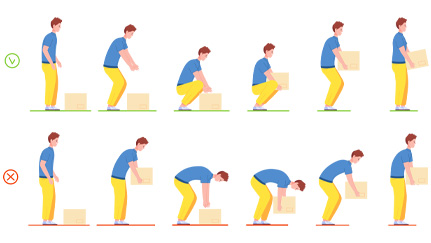
(Illustration shown below)- Stand as close to the load as possible with a wide stance. One foot should be behind the object, the other beside it.
- Bend at the knees with a straight back and a tight stomach.
- Grip the load firmly at opposite corners. Tighten your stomach muscles and keep you back straight.
- Lift smoothly with your legs, while holding the load close to the center of your body.
- When setting the load down, tight stomach muscles, keep back straight and bend at the knees until your back is in the same position as you were when you first lifted the object.
Reminders:
- Plan ahead
- Use proper lifting steps
- Safest lifts are between shoulders and knees
- Limit the weight you lift to no more than 50lbs1
- Get help or use lifting/carry aids if the load is too heavy, bulky, or awkward to lift alone.
- Never twist when lifting.
- Change direction by moving your feet and your body.
- Always wear appropriate PPE, especially if the load has sharp edges, subject to splinters, subject to chemicals or thermal burns, etc.
- Make sure the load is balanced properly before attempting to lift.
Confirm review of this toolbox talks article.