
To learn more about securing your financial future, check out our Living Well in Retirement webinar.
Managing your finances in retirement is key to feeling confident about your spending and making your savings last. These practical tips can help you make informed decisions and enjoy greater peace of mind throughout your retirement years.
1. Build a budget that works for retirement
Creating and maintaining a budget is just as important in retirement as it was during your working years. A well-planned budget helps you understand where your money is going and gives you a clear view of your financial landscape.
If you already have a budget, review it regularly and adjust it as your expenses or priorities shift. If you’re starting from scratch, begin by listing all your expenses. This includes monthly bills like housing and utilities, as well as periodic costs such as insurance premiums, property taxes, and annual memberships. Don’t forget lifestyle expenses like hobbies, travel, or gifts. Be sure to include contributions to an emergency fund.
Next, list all your income sources. These might include Social Security, retirement account withdrawals, pensions, annuities, dividends, rental income, or other streams. If you’re unsure of the exact amounts, review your financial statements to get a clearer picture.
Finally, compare your income to your expenses. If your spending exceeds your income, look for areas to cut back, such as unused subscriptions or discretionary spending. If you have a surplus, consider how to allocate it intentionally, whether that’s saving, investing, or supporting causes you care about. A financial professional can help you make confident decisions that align with your goals.
2. Be strategic about claiming Social Security
Deciding when to start receiving Social Security benefits is one of the most important financial choices you’ll make in retirement. The age at which you claim will affect the size of your monthly benefit for the rest of your life.
If you're married, coordinating your claiming strategy with your spouse can help you maximize your combined benefits. Some couples benefit from staggering their start dates, depending on income needs and life expectancy.
You can begin collecting benefits as early as age 62, but claiming early will reduce your monthly amount. On the other hand, delaying benefits can increase your monthly payment. The right timing depends on your financial situation, health, and whether you plan to continue working.
If you’re still earning income in retirement, your benefits may be temporarily reduced if you haven’t yet reached full retirement age. However, once you reach that age, your benefit will be adjusted to account for any amounts that were withheld due to earnings.
To better understand how Social Security fits into your retirement plan, consider watching our on-demand webinar, Basics of Social Security.
| Birth year | Full retirement age |
|---|---|
| 1943-1954 | 66 |
| 1955 | 66 + 2 months |
| 1956 | 66 + 4 months |
| 1957 | 66 + 6 months |
| 1958 | 66 + 8 months |
| 1959 | 66 + 10 months |
| 1960-later | 67 |
3. Prepare for Required Minimum Distributions (RMDs)
Tax-deferred retirement accounts offer the benefit of postponing taxes, but eventually, the IRS requires you to begin taking withdrawals. These mandatory withdrawals are called required minimum distributions, or RMDs.
RMDs apply to traditional retirement accounts such as 401(k)s. It’s important to take RMDs on time and in the correct amount. Missing a required distribution or withdrawing too little could result in a significant tax penalty, in addition to regular income taxes on the full amount.
If you don’t need the income when RMDs begin, consider working with a financial professional. They can help you explore strategies to manage your distributions in a way that aligns with your goals and may reduce your tax burden.
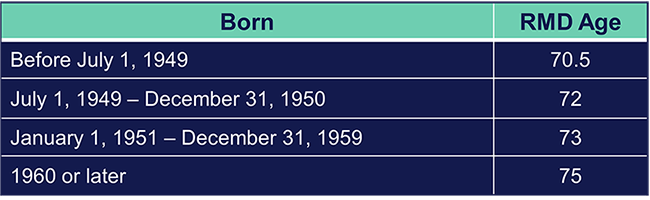
Once you reach the age when required minimum distributions begin, you’ll need to take your first withdrawal by April 1 of the year following the year you reach that age. After that, RMDs must be taken by December 31 each year.
If you delay your first withdrawal until the following year, you’ll need to take two RMDs in that year. This could increase your taxable income and potentially place you in a higher tax bracket.
If you’re still working and contributing to your employer’s retirement plan when you reach your RMD age, you may be able to delay RMDs from that specific account until after you leave the company.
To calculate your RMD, divide your account balance as of December 31 of the previous year by a life expectancy factor based on your age. These factors are published in IRS Publication 590-B (PDF). If your retirement account is with a provider that offers RMD services, they may automatically calculate and distribute the correct amount for you each year.
4. Know how taxes affect retirement income
Understanding how taxes apply to your retirement income can help you plan more effectively and avoid surprises. Different types of income are taxed in different ways, which can influence how much money you actually have available to spend.
In general, retirement income may be subject to two types of taxes:
- Ordinary income tax applies to wages, withdrawals from certain retirement accounts, a portion of Social Security benefits, and interest earned on savings.
- Capital gains tax applies to profits from selling investments. You’re typically taxed only on the increase in value from the time you purchased the investment to the time you sell it.
Some income is fully taxable, some is partially taxable, and some may be tax-free. Knowing which category your income falls into can help you estimate your tax liability and explore strategies to reduce it. A financial professional can help you make informed decisions based on your specific situation.
How Retirement Income Is Taxed
Understanding how different types of retirement income are taxed can help you plan more effectively and avoid surprises at tax time. Here’s a breakdown of how various income sources may be treated:
Taxable Income
You’ll typically pay taxes on:
- Withdrawals from traditional retirement accounts, including 401(k) and IRAs
- Payments from most pension plans
- Profits from selling investments held for more than a year, which may be subject to long-term capital gains tax
- Gains from investments sold within a year, which are taxed as ordinary income
- Distributions from annuities purchased with pre-tax dollars
Partially Taxable Income
You may owe taxes on a portion of:
- Income from annuities purchased with after-tax dollars
- Social Security benefits, depending on your total income and filing status
- Withdrawals from permanent life insurance policies, where only the gains are taxable
Tax-Free Income
Some income sources are generally not taxed, including:
- Qualified withdrawals from Roth IRAs and Roth workplace retirement plans
- Distributions from health savings accounts (HSAs) used for eligible medical expenses
- Interest from municipal bonds
- Payments received from a reverse mortgage
While federal tax rules apply across the board, state tax laws can vary. Some states follow federal guidelines closely, while others have their own rules for taxing retirement income. It’s important to understand how your state treats different types of income so you can plan accordingly.
One way to potentially reduce your overall tax burden is by being strategic about the order in which you withdraw funds from your accounts. A common approach is to draw from taxable accounts first, then tax-deferred accounts, and finally tax-free accounts like Roth IRAs. However, the best order for you may depend on your income needs, tax bracket, and other financial goals—and it could change from year to year.
A financial or tax professional can help you evaluate your options and create a withdrawal strategy that aligns with your long-term plan.
5. Take Control of Debt in Retirement
Carrying debt in retirement can limit your financial flexibility and increase stress. Creating a plan to reduce or eliminate debt can free up money for other priorities and improve your overall quality of life.
Here are a few strategies to consider:
- Build an emergency fund to cover unexpected expenses like car repairs or medical bills. This can help you avoid taking on new debt.
- Explore options to consolidate or refinance high-interest debt. Compare offers carefully and make sure you understand the terms before making a decision.
- Look for ways to reduce monthly expenses, both fixed and variable. Use any savings to pay down the existing debt.
- Consider increasing your income by selling items you no longer need or exploring part-time work or passive income opportunities.
- Work with a financial professional or a reputable credit counselor to create a personalized debt management plan.
For more tips about taking control of debt, see Smart strategies to take control of your debt.
For more insights on living in retirement, review our resources for soon-to-be and current retirees.