
See what goes into your credit score, why it matters for big money decisions and how to check yours.
What you'll learn:
- What a credit score is
- What can influence your score
- How to check your credit reports and score
Credit plays a bigger role in your everyday life than you might think. It affects everything from getting approved for a credit card or renting an apartment to the interest rate you’ll pay on a car or home loan. At its core, credit is simply your ability to borrow money and pay it back over time. Lenders look at your credit history and your credit score to decide how confident they feel lending to you.
Here’s a simple look at what a credit score is, what shapes it and how to check yours.
What is a credit score?
A credit score is a 3-digit number, usually between 300 and 850, that shows how likely you are to pay your bills on time. You can think of it as a financial trust indicator — it tells lenders how much they can rely on you to repay what you borrow. The higher your score, the easier it may be for you to qualify for loans and credit cards and the more likely you are to get a better interest rate.
Most lenders use scoring models created by FICO® or VantageScore®. Both look at information in your credit reports to estimate your credit risk – how likely you are to pay borrowed money back.
Common credit score ranges
Many credit scores, including some FICO® and VantageScore® models, use a 300 to 850 scale, but specific ranges can vary by lender and scoring model.
| Credit score range | Category |
|---|---|
| 300-579 | Poor |
| 580-669 | Fair |
| 670-739 | Good |
| 740-799 | Very Good |
| 800-850 | Exceptional |
Why does a credit score matter?
Your credit score can influence major financial moments — renting a place to live, getting a mortgage or securing a good rate on a car loan. A stronger score often means you’ll pay less in interest, which helps keep costs down and leaves more room in your budget for the things that matter to you.
Here’s an example:
Let’s say Taylor applies for a car loan. She has a long history of paying her bills on time, keeps her credit card balances low and only applies for new credit when she needs it. Because of those habits, her credit score is strong. When she shops for a car, lenders offer her a lower interest rate, making her monthly payments easier to manage.
Her friend Ethan has missed credit card payments and is using most of his available credit. He wants to buy the same car as Taylor, but his credit score is lower so he’s offered a higher interest rate for the loan. Over time, Ethan ends up paying more for the same vehicle because he’s paying more to borrow the money.
Want ideas to improve your credit score?
What goes into your credit score?
FICO and VantageScore weigh these factors differently, but both look at the same general categories. Here are 5 of the main factors that can shape your score.
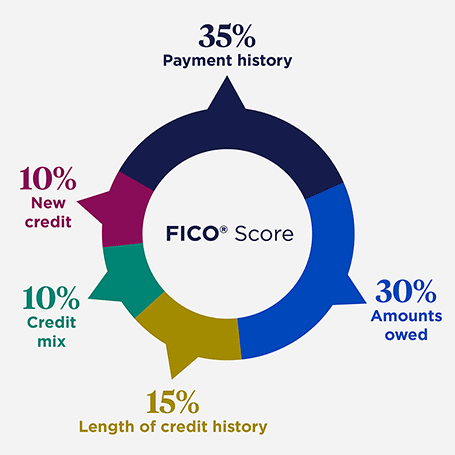
1. Payment history
This is the biggest factor. It reflects whether you pay your bills on time. A payment typically isn’t reported late until it’s at least 30 days past due, but once it is, the impact can be significant.
2. Amounts owed (credit utilization)
This looks at how much of your available credit you’re using. Using a high percentage of your credit can signal higher risk to lenders. Keeping utilization under 30% — and ideally under 10% — supports a healthier score.
3. Length of credit history
This includes how long your accounts have been open and how long it’s been since you used them. A longer history generally helps your score.
4. Credit mix
Lenders like to see that you can handle different types of credit, such as credit cards, student loans, auto loans or a mortgage.
5. New credit
Opening several new accounts in a short period can lower your score temporarily. Hard inquiries — the checks lenders run when you apply for credit — show up here.
VantageScore differences
VantageScore models weigh these factors slightly differently. For example, payment history makes up about 40% of a VantageScore 3.0 score, compared with 35% in the FICO model. The categories, however, remain similar across both.
Where credit score information comes from
Your score is built from the data in your credit reports, which are maintained by 3 nationwide credit reporting agencies: Equifax, Experian and TransUnion. They collect information from lenders about your balances, payment history and account status.
How to check your credit reports and scores
You can get free copies of your credit reports from all 3 credit bureaus once a year at annualcreditreport.com. These reports include the information used to calculate your score but not the score itself.
Your credit score may be available through your bank, credit card company or certain financial apps, depending on the institution.
Ready to put these ideas into action?
Use our article, "30-day plan to build your credit score," as a 4-week checklist.