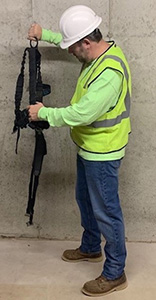
Every harness must have a tag that is legible and contains the manufacturer’s name, harness model, manufacture date, limitations, and warnings.
Fall protection equipment must be inspected prior to every use.
Fall protection equipment must be inspected in accordance with manufacturer specs.
Fall protection equipment must be stored properly.
Conducting a visual harness inspection:
- Inspect equipment for loose or broken stitching, cuts, burn marks, fraying or abrasions, or any evidence that would lead you to believe the strapping or fabric has been weakened.
- Inspect equipment components for defects, rust, rough or sharp edges, cracks, and modifications
Proper harness storage:
Equipment should be hanging or lying flat in a designated storage area. Storage area should be dry and free from:
- direct sunlight
- excessive heat/steam
- weather
- corrosive elements
*Follow manufacturers specifications when cleaning fall protection equipment.
Why fall protection equipment matters
Falls are still the leading cause of death for construction employees, and they are preventable. The Bureau of Labor Statistics show falls from elevation account for 423 of the 1,056 fatalities recorded in 2022.1 Fall protection could be your last line of defense, don’t become a statistic.