

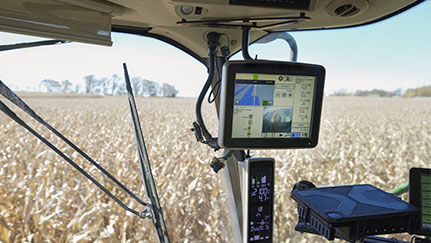
Running a farm, ranch or dairy takes a unique, specific mix of experience, local expertise and gut instinct. Now there’s rapidly advancing technology that can help create new competitive advantages if it’s used correctly.
Artificial intelligence (AI) is changing the way just about everyone works in agriculture, from small daily tasks to broad business-wide decision-making. With its integration into everything from smartphones to farm machinery, AI has officially moved from an experiment to a fundamental tool in agriculture. But just like a planter, tractor or dairy barn, AI presents risks that need to be understood.
While AI offers new levels of efficiency, it also fundamentally changes every farm, ranch and dairy's risk profile. Understanding these shifting liabilities is an important step to ensure you can confidently protect your operations and livelihood as your agribusiness evolves.
What is AI?
Artificial intelligence refers to computer systems and algorithms that perform tasks typically requiring human intelligence. These tasks include learning, reasoning, problem-solving and decision-making. As AI “models” perform these kinds of tasks, they learn patterns in data that enable them to make predictions and decisions. The more data that fuels an AI model, the more it learns and grows its decision-making capabilities.
Agriculture is a business where AI has a lot of applications, both for crop and livestock producers. “Tools like drones and satellite imagery equip farmers with the ability to continuously monitor crops,” said Mississippi State University Agricultural Autonomy Institute Director Alex Thomasson. “Combine that with AI and farmers can now see crop stress before it’s visible to the eye so they can take action quicker and prevent crop losses.”
How AI is used on the farm
The true value of this technology happens directly in your fields. In some ways, it’s no different from other agricultural innovations over the years.
"We need to stop viewing AI as a single, obscure technology and start seeing it as a layered system of infrastructure,” Thomasson said. “An AI model doesn’t create value until it changes a workflow or improves a decision that affects a tangible outcome."
One example of this is the integration of AI into crop management software platforms that drive automated decision-making for disease predictions. Sprayers with AI camera technology help detect and precisely treat weeds in real time. For beef or dairy producers, AI-enabled camera systems and feed monitoring systems can detect illness in an animal based on its movement or feed consumption. All these examples exemplify the value of AI, but more importantly show how it is changing the role of the human operator.
"The farm machinery operator’s role is shifting from control to supervision,” Thomasson said. “Not all decisions are being made by the farmer anymore; many are shared between the human and the software.
How AI changes farm risk exposure
With this change comes a new set of exposures. When decisions move from the person in the tractor to an AI model, the associated risks move with them. And AI is not always perfect and the human operator — whether you manage a farm, ranch or dairy — will remain a critical driver of successful AI adoption in agriculture.
“The human element is still critical in supervising the decision-making process,” Thomasson said. “No model is accurate 100% of the time.”
AI can introduce entirely new exposures to your operation. "When decisions move from people to systems, risk moves with them,” Thomasson said. “Always ask yourself: ‘Who owns the decision when something goes wrong?’”
Talk with a Nationwide Farm Certified agent today to learn more about comprehensive coverage options designed for the modern, data-driven farm, ranch or dairy operation.