Common Ground Alliance’s Damage Information Reporting Tool (DIRT)1 estimates damage to buried utility lines happens in more than 450,000 events each year. Of these events, 70% were due to improper work practices, including no locates being called prior to digging. Help avoid underground utility line strikes by sharing best practices with front line employees.
Tips for avoiding underground utility line strikes:
- Pre-mark excavation sites with white paint.
- Call 811, or your state’s public utility locate service, before any underground work begins.
- Designate a person to handle communication and positive responses from locate company (e.g. unlocatable, blocked access, etc.) and relay to the field.
- Ensure field employees and supervisors know it is their responsibility to maintain accuracy of original locate marks through the life of the ticket or project, whichever is less.
- Engage a private locate company for customer/private owned utilities or non-conductible/non-metallic underground utilities.
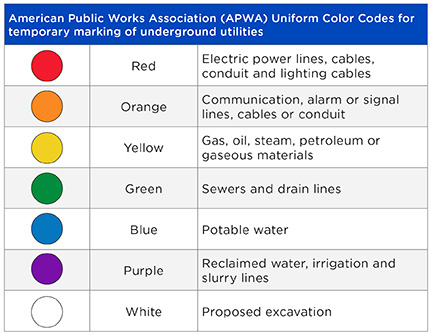
- Review and test employees on the American Public Works Assoc. (APWA) Uniform Color Codes.
- Educate employees that locate markers are approximate and not designed to provide exact location or depth.
- Ensure employees understand your state’s tolerance zone, which is the area on either side of an underground utility plus the width of the utility itself. The tolerance zone can range from 18-30” depending on the state.
- Utilize non-destructive or soft digging methods such as hand digging, vacuum & hydro excavating, etc., when operating within the tolerance zone.
- Pickaxes or digging bars should not be used during soft digging.
- Consult with utility owners on max allowable PSI for certain utilities prior to air or hydro excavating techniques.
- Ensure you properly support exposed utilities with materials that will not damage the utility.
- Remember the Three S’s when working near gas lines:
- Sight: Look for any damage to the pipe, bubbling of water, blowing dirt, or decaying vegetation.
- Smell: Be aware of any odd odors. Utility companies often add a chemical to the gas lines that creates an odor when released.
- Sound: Listen for any hissing, blowing, or roaring sounds coming from the pipeline.
Why preventing line strikes matters
If struck or damaged, underground utilities have the potential to endanger lives, damage nearby property, and interrupt business operations. In addition to the danger and inconvenience, there can be significant cost to the contractor to repair the systems and reimburse companies for lost revenue.