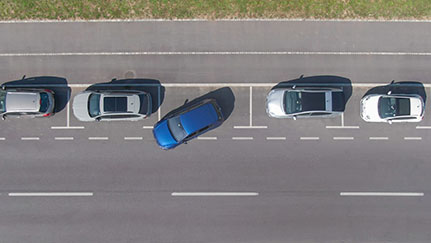
1. Ensure that the parking space is large enough
Look for a space that’s at least 1 1/2 times as long as your vehicle, which will provide buffer room as you park. (More experienced drivers may be able to park with less room.)[2]
Double-check signs to be sure it’s a legal parking spot and confirm whether you need to pay for parking.[3]
2. Move your car up to the car parked in
Drive up next to the car you’ll eventually park behind, leaving 2 to 3 feet between the sides of the cars. Pull up until your rear-view mirror is aligned with the parked car’s rear-view mirror.[2]
3. Check your rearview and side mirrors
Double-check the adjustment of your mirrors before starting to back into the space, then scan the mirrors and your blind spot for pedestrians and vehicles. When you’ve confirmed that things are clear, you’re ready to put your vehicle in reverse.[1]
4. Reverse and turn the steering wheel to the right
As you back up, begin turning your wheel toward the curb. When your seat is lined up with the back of the vehicle you’re parking behind, smoothly and quickly turn the steering wheel to the opposite direction. Your goal is to have your vehicle at a 45-degree angle as you reverse into the parking space.[3]
5. Align the steering wheel and continue backing up
Begin straightening the steering wheel when you’re most of the way into the space. A visual clue you can use is to start straightening the wheel once your front bumper is next to the rear bumper of the car you’re parking behind. As you do this, your vehicle will become positioned in the parking space.[3]
6. Check the distance between the parked cars and center your vehicle
Now that you’re in the space, check the distance between yourself and the car in front of you and behind you, and adjust forward or backward as needed to center your vehicle. Be sure to allow room for yourself and the other cars to pull out.[3]
Finally, once your vehicle is in place, if you’re parked on a hill or incline, turn your wheels toward the curb or at an angle that would guard against rolling into traffic.[2]
Tips for parallel parking
- Practice with cones: Using cones allows you to get comfortable with the size and shape of the average parking space without worrying about hitting another car.[1]
- Practice on quiet streets: Streets without much traffic or parking lots with plenty of open spots are great options for becoming more familiar with your vehicle’s size and the room you need to park without difficulty.[1]
Discover more driver safety
Our tips can help new drivers feel safe and comfortable on the road. Learn more about the important protection that auto insurance offers.
Sources
[1] “How to Parallel Park: 10 Ridiculously Easy Steps,” driving-tests.org/beginner-drivers/how-to-parallel-park (accessed January 2026).
[2] “How to Parallel Park for Beginners: Step-by-Step Guide,” zutobi.com/us/driver-guides/how-to-parallel-park (accessed January 2026).
[3] “How to Parallel Park: Tips & Tricks for Smooth Parking,” wikihow.com/Parallel-Park (accessed January 2026).