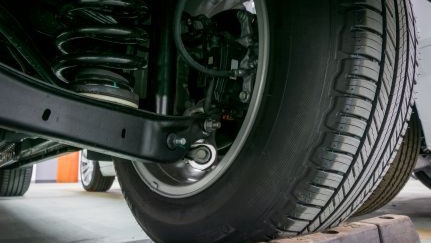
Press the gas pedal, and it goes. Hit the brakes, and it stops. But underneath the seamless design of a car there’s a lot of complexity. Many parts work together in perfect synchrony to keep your car running smoothly. One part is important for connecting your engine to the wheels it powers: the axle.
What is a car axle?
Have you ever wondered how the power generated by your car’s engine makes the wheels turn? You can thank the axle for that. Your engine applies force against the axle (a rod or shaft connecting two wheels) which then transfers that force, causing the wheels to spin. In other words, the axle is a car part that serves a dual purpose: connecting the wheels of your car and delivering the power from the engine that moves them forward or backward.[1]
How many axles does a car have?
Generally, a vehicle has one axle for every two wheels. The axle connects one wheel on one side to another wheel on the other side. And because cars have four wheels, they have two axles.[2] As you might expect, larger vehicles sometimes have more axles. There might be an extra axle in a large pickup truck, for example.
Front axle vs. rear axle
Generally speaking, there are two kinds of axles in a car: live axles and dead axles. Live axles rotate with the wheels and transfer engine power to them, while dead axles are simply load-bearing.[1] In cars, the front axle and rear axle can both be live, as in the case of cars with four-wheel drive; however, most standard passenger cars feature a front-wheel drive system.[3]
The parts of a car wheel and axle vary between the front and rear axle. The rear axle of a car is typically comprised of two connected halves known as half shafts.[2] Front axles bear the responsibility of steering the car and absorbing shocks from uneven surfaces.[1]
Why should you inspect your axles?
A broken axle, to put it plainly, is not a good thing. As sturdily as they’re built, having safely functioning axles in your car is critical, and you should treat them accordingly. If an axle breaks while you’re driving, you could lose control of your vehicle. Having your front and rear axles inspected regularly can help prevent this from happening.
Axle damage symptoms
You should pay close attention to your vehicle for any signs of deterioration and bring it in for inspection accordingly. Symptoms such as wobbly steering or the feeling of tire misalignment could point to signs of a degraded axle. A car axle showing such signs may require attention from a mechanic.[4]
Are axles covered by insurance?
Like any part of your car, whether axles are covered by your insurance depends on the nature of the damage they’ve taken. For specific coverage questions, you can always talk to an insurance agent.
Regular maintenance and inspection are important. And so is being prepared for the unexpected.