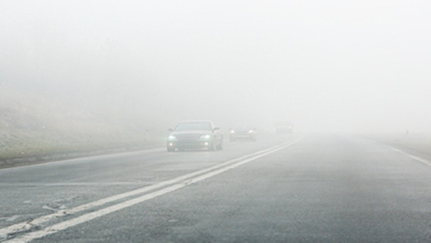
At one point or another, you’ve probably had to drive through some kind of bad weather. While driving in fog isn’t the same as driving in a thunderstorm or blizzard, it can still create problems for your commute if you’re not careful. Foggy conditions, in particular, can greatly reduce your visibility, potentially causing dangerous driving situations and car accidents. Navigating through fog is difficult for new and experienced drivers alike, so it’s important to understand how to deal with it when you’re on the road.
What causes fog?
According to the National Environmental Satellite, Data, and Information Service (NESDIS), what causes fog to occur is the condensation or freezing of water vapor. When this happens, small droplets form in the air.[1]
There are many types of fog, each of which forms in its own unique environment. Just know that when fog is considered dense, it means your visibility will be decreased to a quarter mile or less.[2]
10 safety tips for driving in fog
The best way to stay safe in fog is to avoid driving entirely or pull over and wait for the fog to dissipate. But if you do have to drive in fog, follow these 10 safety tips.
1. Use low beam headlights and fog lights
When driving in fog, you should use your low beam headlights and fog lights, never your high beam headlights. High beams can reflect off the fog and cause glare.[3]
2. Drive more slowly
In fog, it’s going to be difficult to see the road and the vehicles around you. By decreasing your speed, you’ll be better able to stop and react safely to anything you come across.[4]
3. Increase following distance
Increasing the following distance between you and the vehicle ahead of you will give you more room to brake and adjust to changes in traffic.[3]
4. Use your windshield wipers and defroster
Reducing excess moisture is key to seeing in the fog. Use your windshield wipers and the defroster as needed to keep your vision clear and glare-free.[3]
5. Remove distractions
In foggy conditions, you want to focus on the road. Turn off your stereo, don’t check your mobile phone and minimize any other distractions.[5]
6. Listen for vehicles in the distance
You probably won’t be able to see cars on the road when it’s foggy. If possible, roll down the window to listen for any cars or emergency vehicles in the distance.[3]
7. Watch out for animals
Just as fog can keep you from seeing other vehicles, it can also prevent you from seeing animals on the road. Be extra cautious in areas where deer and other animals on the road might be a concern.[6]
8. Turn off cruise control
You want to have as much control of your vehicle as possible when driving in fog. Turn off cruise control so you’re able to quickly react to whatever comes your way.[4]
9. Follow lane lines and reflectors
Follow the road’s lines and reflectors to guide your way in fog. Staying to the right edge, where the solid white line is located, can be especially helpful.[4]
10. Avoid passing lanes
When fog conceals your surroundings, avoid changing lanes or trying to pass a vehicle in front of you. Doing so increases your chances of running into an unseen obstacle.[3]
Regardless of weather conditions, it’s important to have auto insurance so you and your vehicle are protected while on the road. Learn about the various types of coverage Nationwide offers.