Auto links
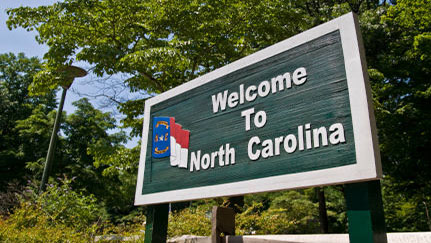
Residents of the Old North State enjoy scenic temperate mountain ranges, beautiful subtropical beaches and arenas offering most of America's favorite professional sports. Whether you're heading to Charlotte to catch a game, cruising one of Raleigh's scenic byways or taking the Durham Freeway to work, make sure your vehicle is protected by coverage from Nationwide.
Explore coverage options in North Carolina and find new ways to save while protecting yourself and your vehicle.
Take advantage of Nationwide's features
Nationwide makes it easy for you to find dependable auto insurance in North Carolina. We can show you options so you can choose the coverage that's right for your needs, goals and budget.
Explore the features below to learn more about what we can offer you:
On Your Side® Claims Service
Choose a shop in our network to get a written guarantee on repairs for as long as you own your vehicle.1
Discounts helping you save
We offer many ways to help lower your auto insurance rates. See the many ways you can save with qualifying discounts.
On Your Side® Review
Enjoy a free consultation with an agent who's here to help you get the protection you need at the price that's right for you.
Resources at your fingertips
Make payments, print ID cards, report claims and more, quickly and easily online. We even have a mobile app for on-the-go account access.
North Carolina car insurance discounts
Nationwide makes it easy to find affordable car insurance. Find out which discounts can be applied to your policy by applying online for a quote or speaking with your local agent. Nationwide offers a range of car insurance discounts that can help lower your monthly premium, you may be eligible for these exclusive discounts below:
Multi-policy
When you have Nationwide as your insurance provider you can bundle your car insurance policy with home, renters, boat, and multi-car. By protecting your property with Nationwide, you can save money and simply your life.
SmartRide® program
SmartRide rewards safe driving. Get an instant discount when you sign up. The safer you drive, the higher the discount you could earn.2
Good student
Nationwide offers a student discount for drivers age 16 to 24 who maintain a B average or better and are full-time students.
Defensive driving
This discount applies to drivers age 55+ who have completed and passed a state-approved defensive driving safety course.
Anti-theft
If you have an anti-theft device installed in your car you may be eligible for a discount. Savings vary based on the type of device installed. Proof of installed device may be required.
Safe driver
It is important to maintain a clean driving record. If you have at least 5 years of safe driving, you could be eligible for safe driver discount.
Automatic payments
You may be eligible for a billing discount when you select a qualifying payment option:
- Scheduled Bank Payments (Recurring EFT): When you set up automatic monthly payments from your checking or savings account.
- Pay in Full: When you pay your entire policy premium upfront.
Both options are convenient, help you avoid missed payments, and mean one less bill to manage each month.
Accident free
When you maintain an accident-free driving record you could earn up to 10% reduction in your monthly premium.
Save up to 20% when you bundle home and car insurance with Nationwide.
Find Nationwide Insurance near you in North Carolina
Get a free auto insurance quote
Car insurance laws in North Carolina
As a resident of North Carolina, you are required to carry car insurance and purchase coverage before you register your vehicle. Insurance coverage and cost may also vary depending on where within the state you live. Before you get started, here are some important factors to keep in mind:
North Carolina teen driving laws
Young drivers are eager to get out on the road and experience that kind of freedom for the first time in their lives. To ensure safety on the road for everyone, it’s important to become familiar with the laws for new drivers in North Carolina.
New drivers can apply for their learner’s permit once they turn 15 years old. After one year, a teen may apply for a level two permit, followed by after six months they can apply for a level three provisional full license. You can learn more about the rules a young driver in North Carolina must follow here.
Minimum insurance requirements for North Carolina
The minimum amount of North Carolina auto insurance coverage is $50,000/$100,000/$50,000. In the event of a covered accident, your limits for bodily injury are $50,000 per person, with a total maximum of $100,000 per incident. It also covers up to $50,000 for damage to another person’s property.
Liability coverage
Liability may cover certain legal defense expenses if you are sued for a covered accident. As a resident of North Carolina, there are two types of liability coverage your insurance policy must include: property damage and bodily injury.
- Property damage safeguards your assets if you are found legally responsible for a covered accident. It covers certain damage you may cause to the property or vehicle of another party.
- Bodily injury safeguards your assets if you’re found legally responsible for a covered accident, including certain expenses associated with bodily harm sustained by the other parties.
Optional North Carolina insurance coverage
It’s often a good idea to add the following coverages to your policy so you can enjoy the security of being protected on the road:
Comprehensive
This type of North Carolina auto insurance coverage is used to repair your vehicle when physical damage occurs from non-collision related incidents (subject to deductible). Such incidents include theft, fire, vandalism, glass breakage, and contact with animals.
Collision
Collision coverage is used to repair your vehicle when physical damage occurs from collision with another vehicle or object (subject to deductible).
Uninsured/underinsured motorist
Protects you in the event of an accident where the other party is at-fault and either doesn’t carry insurance or whose insurance limits are not enough to reimburse you for damages they caused.
- Bodily injury may protect you if you’re involved in an accident and the other party is at-fault and either is uninsured or doesn’t carry enough insurance to cover costs related to your bodily injury damages.
- Property damage may protect you if you’re involved in an accident where the other party is at-fault and uninsured/underinsured for damages sustained to your vehicle and other covered property (subject to deductible). You do not need Uninsured/Underinsured property damage coverage if you have collision coverage.
Medical benefits
May pay for necessary medical expenses or funeral costs for you or others covered under the policy, no matter who is at fault.
Frequently asked questions
Do you need insurance to get your driver’s license in NC?
Yes, liability insurance is required to obtain a driver’s license in North Carolina and must be issued by a company licensed to do business in North Carolina.
When heading to the DMV you will need to provide proof of liability insurance. Each driver must be listed on the document provided for liability insurance when applying as a new driver. An example of an acceptable document to bring to the DMV is an insurance policy from a North Carolina-licensed insurer that shows the dates the policy was issued and became effective.
Do you need car insurance in NC?
Car insurance is required by North Carolina state law G.S. 20-309. North Carolina drivers must carry and have proof of continuous liability insurance. Out of state policies are not accepted.
Nationwide coverage in North Carolina
[1] Guarantee is limited to alternative parts identified on appraisal and used in repair. Also, work performed at an On Your Side Auto Repair Center includes workmanship guarantee. For informational purposes only. Program terms and conditions are controlling.
[2] Discounts do not apply to all coverage elements; actual savings vary by state, coverage selections, rating factors and policy changes. Enrollment discount applies during data collection; final discount is calculated on driving behavior and could be zero. Final discount applies at the next policy renewal and remains until drivers or vehicles on the policy change.
Insurance terms, definitions and explanations are intended for informational purposes only and do not in any way replace or modify the definitions and information contained in individual insurance contracts, policies or declaration pages, which are controlling. Such terms and availability may vary by state and exclusions may apply.